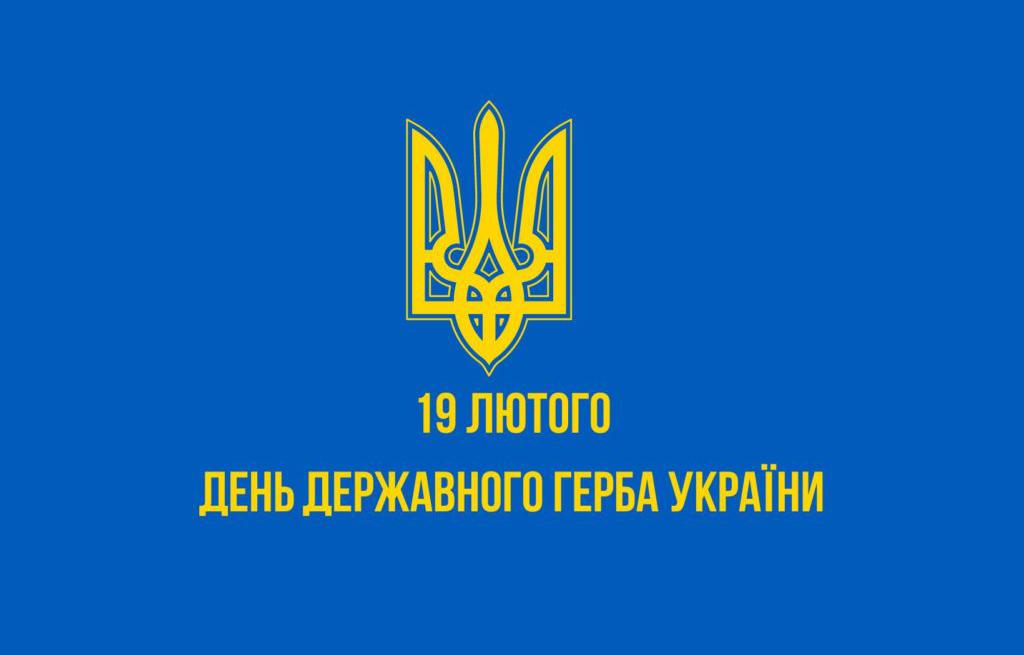
According to the Constitution of Ukraine, the Great State Coat of Arms of Ukraine is established taking into account the Small State Coat of Arms of Ukraine and the coat of arms of the Zaporozhian Army. The main element of the Great State Coat of Arms of Ukraine is the sign of the Princely State of Volodymyr the Great. The coat of arms is the official symbol of the state of Ukraine in the form of a golden trident on a blue shield. It is one of the three state symbols of Ukraine along with the flag and anthem. The trident was approved as the small coat of arms of Ukraine on February 19, 1992 by a resolution of the Verkhovna Rada together with its graphic image. In 1996, its status was enshrined in Article 20 of the Constitution of Ukraine, where it is also mentioned as the “Sign of the Princely State of Volodymyr the Great”.
The first chronicle mention of the trident as a princely sign of Kyivan Rus dates back to the 10th century. It was preserved in the Bulgarian manuscript "Chronicle of Manasseh" (14th century), which depicts warriors - the druzhinniks of the great Kiev prince Sviatoslav, in whose hands the banners are crowned with a trident. The trident was also depicted on the coins of the great Kiev prince Volodymyr Sviatoslavovich, and later of the princes Yaroslav the Wise, Volodymyr Monomakh. Initially, this sign was not an official coat of arms, but acted only as a tribal sign of the princes. However, over time, it was inherited as a symbol of power and a sign of unity of the Eastern Slavs, that is, it became a coat of arms itself.
Currently, there are more than 40 versions that explain the origin and interpret the essence of the trident. All current explanations of the trident can be collected into 6 main groups that unite homogeneous hypotheses: 1) a symbol of state power (the upper part of the scepter or crown); 2) a church Christian emblem (Trinity, dove of the Holy Spirit); 3) military emblem (francisca (spear with a double axe), anchor, bow and arrow, helmet, axe, spear with trident tips); 4) heraldic-numismatic figure (Norman raven or falcon, Genoese-Lithuanian portal); 5) monogram (interweaving of several initial letters in the form of a monogram to denote a name, word or expression), (schematic representation of the word volya, symbol of power over three (heavenly, earthly, underground) worlds, the letter "Ш", which meant the number 3, a symbol of the combination of the past, present and future); 6) geometric ornament (stylized flower (trident), ear of corn).
After the collapse of Kyivan Rus, the trident temporarily lost its meaning as a state symbol, remaining on the coats of arms of provincial cities, Ukrainian magnates, nobles and Cossack officers. Another element of the Great State Emblem is a Cossack with a musket and saber as the emblem of the Zaporozhian Army known from the 16th century, and from the 18th century such an emblem becomes a symbolic image of the Hetmanate. In 1918, after the declaration of independence of the UNR, the golden trident on a blue background was approved as the State Emblem of Ukraine. It also remained the emblem under Hetman P. Skoropadsky and the UNR during the Directory.
The Verkhovna Rada of Ukraine at its meeting on August 24, 2021, on Independence Day, supported the draft law on the great emblem in the first reading. According to the draft: The State Emblem of Ukraine is the state symbol of Ukraine, the main element of which is the Sign of the Princely State of Volodymyr the Great (small State Emblem of Ukraine) of gold color, placed on a blue five-sided shield with rounded lower side corners with a gold border; above the shield – an image of the Grand Duke's crown (crown) of Yaroslav the Wise and a purple-gold tent in the form of a floral ornament; the shield is held by: on the left side – a lion (coat of arms of the Galicia-Volyn Principality), on the right – a Cossack warrior with a rifle (coat of arms of the Zaporozhian Army); under the shield – a ribbon of two equally large horizontal stripes of blue and yellow, under the ribbon – two golden ears of wheat intertwined with a chain of purple viburnum with stylized purple-gold leaves. The images of the lion and the Cossack warrior are made in gold with elements of purple.
The Russian attack on Ukraine prevented the approval of the great coat of arms of Ukraine, but the trident remains one of our main symbols of the struggle for independence, freedom and territorial integrity. It is he who is depicted on the uniforms of the Armed Forces of Ukraine, on tanks and planes that destroy enemies in fierce battles. As the Ukrainian poetess Natalka Poklad said:
Our coat of arms is a trident,
This is freedom, glory and strength.
Volodymyr HRECHENKO – professor of Ukrainian history