



How does Parliament work from the inside? What are the real boundaries of a People's Deputy of Ukraine's powers? How do a parliamentarian's political responsibility and constitutional-legal status align, particularly regarding their statutory rights and duties?
These and other questions became the subject of a professional dialogue during a binary class on Constitutional Law themed "Constitutional and Legal Status of People's Deputies of Ukraine," which brought together cadets of Kharkiv National University of Internal Affairs.
The session was co-conducted by Oleksandr Bakumov, People's Deputy of Ukraine, and Tetiana Huds, Head of the Department of Constitutional and International Law and Human Rights.

This format offered an opportunity to examine one of the core institutions of constitutional law not only through normative provisions and academic frameworks, but also through the lens of direct parliamentary experience. After all,the constitutional and legal status of a People's Deputy is more than just a collection of rights, duties, powers, and guarantees. It is a system of legal mechanisms whose proper implementation directly impacts parliamentary efficiency,the execution of the representative function, and the effectiveness of constitutional principles of popular sovereignty.
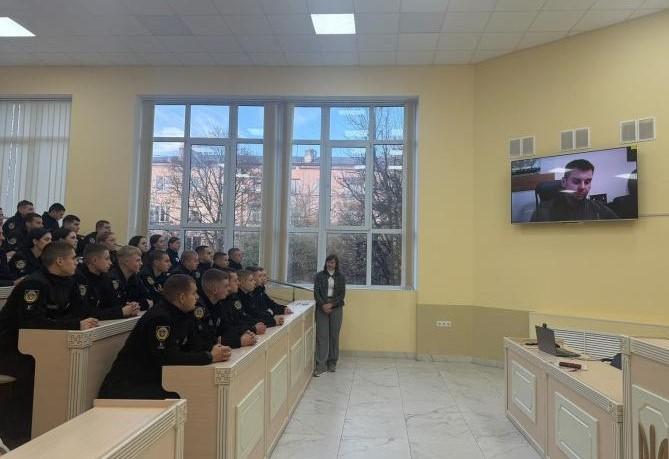
Combining academic analysis with practical insights allowed participants to focus on the nature of the parliamentary mandate, modes of exercising deputy powers, nuances of the legislative process, parliamentary procedures, and issues of accountability.
A vital component of the session was an open dialogue with the cadets. They had the opportunity to address questions directly to the People's Deputy, receive clarifications on practical aspects of parliamentary work, and compare theoretical tenets of constitutional law with the actual operational mechanisms of the Verkhovna Rada of Ukraine.
Such meetings help students realize that constitutional law is not confined to the text of the Constitution and statutes. Its provisions come to life through the activities of state institutions, decision-making processes, adherence to established procedures, and the responsible exercise of public powers.
The binary class served as an exemplary integration of university education with parliamentary practice, providing future law enforcement officers with a deeper understanding of the constitutional foundations governing the organization and exercise of state power in Ukraine.

