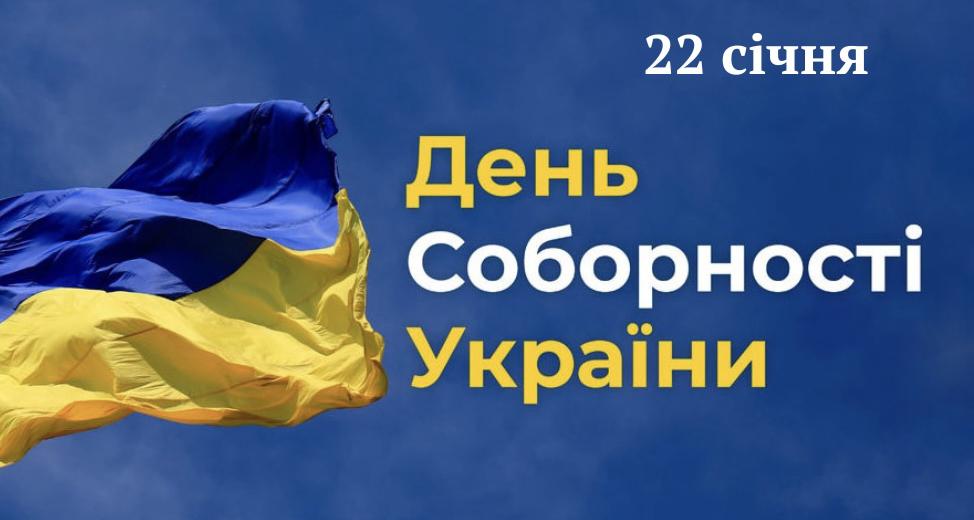
2On January 22, 1919, a significant, grandiose event in Ukrainian history took place - the Act of Unity of Ukraine. It had political, historical and psychological significance. Political - because two republics - the Ukrainian People's Republic and the Western Ukrainian People's Republic united into one state. Historical - because a concrete big step was taken towards the realization of the age-old dream of all Ukrainians - to live in one state - independent and united. And the main historical lesson is that only in unity is our strength, the foundation and the guarantee of our victories. This historical lesson is closely connected with the psychological - the formation of the mentality of the newest Ukrainian political nation - the nation that created a great European state. As the prominent son of the Ukrainian people, Viacheslav Lypynskyi, said: “No one will build a state for us if we do not build it ourselves, and none of us will make a nation if we do not want to be a nation ourselves.” The idea of unity was decisive during the National Liberation War of the Ukrainian people in the mid-17th century, the leitmotif of the activities of the founder of the Ukrainian Cossack State, Bohdan Khmelnytskyi: “I will free from captivity… the whole people!” – he said.
As a result of the first stage of the national liberation struggle in 1917-1918, two democratic states were formed on the territory of Ukraine - the Ukrainian People's Republic (UNR) and the Western Ukrainian People's Republic (WUNR). After some preparatory work, it was decided to hold their ceremonial unification on January 22, 1919. The prominent political and religious figure Ivan Ohienko was appointed the Chief Commissioner of the Council of Ministers of the UNR for the Act of Unification. He included a strong church component in the program - the Act of Unification was to be read in all churches and solemn prayers of thanks were to be offered, and as a sign of great celebration - bells were to be rung, as on Easter. On January 22, 1919, at 12 o'clock in Kyiv on Sophia Square in a solemn atmosphere (the day was declared a national holiday and a day off) the historic ceremony of Unification took place. From the very morning, Kyiv took on a solemn appearance. Ukrainian flags fluttered on all the houses, as planned the day before, and carpets and canvases with bright Ukrainian patterns were hung on the balconies. Christmas tree garlands were intertwined with national ribbons. On the balconies of government buildings, one could see portraits and busts of the three most prominent Ukrainian figures: Taras Shevchenko, Bohdan Khmelnytskyi, and Ivan Mazepa. At the entrance from Volodymyrivska Street to Sofiivska Square, a triumphal arch was built, which was decorated with the coats of arms of the Dnieper Region and Galicia. On the square, the coats of arms of Ukrainian lands and posters were attached to the poles. Lampposts and telephone poles stood for kilometers along the streets in coats of arms, wreaths, and flags. At 11:00 a.m., Ukrainian military units, including artillery and machine-gun teams, began to line up in a quadrangle on the square to the music. High school students with their school administrations lined up in front of the “shpalirs” (boxes) of the military in the middle of the perimeter. At the same time, workers, trade unions, and representatives of other public, city, and zemstvo institutions arrived with national flags and their orchestras. The first to arrive was a delegation of railway workers with a huge banner with the inscription: “Glory to the Ukrainian Heroes!”. To get a better view, some participants climbed trees. The arrangement of the delegations, as well as the entire ceremony, was supervised by the famous Ukrainian actor and director Mykola Sadovskyi (Tobilevich, brother of playwright Ivan Karpenko-Karyi). In a Ukrainian hetman's zhupan, a smoush cap, with a mace and with a "true Cossack mustache" - he stood in a car that moved around the square. The military orchestra played the national anthem "Ukraine is not dead yet", the choir under the direction of the famous musician Kyrylo Stetsenko performed "Eternal Revolutionary", "Prayer for Ukraine" ("God, great, one, save Ukraine for us").
The Act of Unity was opened by the head of the Galician delegation, Lev Bachynskyi, with his greetings, and Longyn Tsehelsky read out the statement of the Presidium of the Ukrainian National Council and the State Secretariat about the will of the ZUNR to unite into one Ukrainian united state. "Today, parts of a united Ukraine that have been separated from each other for centuries - the Western Ukrainian People's Republic (Galicia, Bukovina, Hungarian Rus') and the Dnieper Great Ukraine - are merging together. "The age-old dreams that the best sons of Ukraine lived and died for have come true. Today there is a single independent Ukrainian People's Republic," the universal statement said. After that, Lev Bachynskyi presented a certificate to the Head of the Directorate, Volodymyr Vynnychenko. So that everyone present could hear the letters, they were relayed by deacons-exclaimers - to the cries of "Glory!" - from special stands at all four corners of Sophia Square. The bell rang on the Mazepa bell tower in Sophia Cathedral (built at his expense in 1699-1706), the bells rang in all churches from 13:00 to 15:00. Cannon shots were heard from Pechersk - 121 volleys in honor of the United Ukraine! Many people cried with emotion. They sang "Eternal Memory" to those who fell in the fight for the freedom of Ukraine, and "Many Years" to the Directory, the Ukrainian people and the army. After that, the military parade began. As Longin Tsegelsky recalled: “And they sailed… regiments after regiments: infantry, artillery, cavalry, Sich riflemen, Hutsuls, Haidamaks. The people immediately looked in silence with surprise at the regiments that were regularly parading and saluting. But when a group of Sich riflemen in iron helmets arrived, clapping like spruce, all like fir trees in Chornohora, so that under their march the earth groaned – the crowd could not stand it: “Glory! Glory to the riflemen!” thundered from hundreds of thousands of chests and tears of joy shone in everyone’s eyes.”
However, the unification of the UNR and the ZUNR into one state due to a number of circumstances was not then brought to its logical conclusion. The two national Ukrainian formations formed, rather, a confederal state union. The union of the ZUNR and the UNR was more symbolic than state-legal in nature. The parties that united did not have enough state-building forces to survive in the difficult conditions of that time.
The dream could not be fully realized, but it remained. As a goal, as a lesson, as an unburned bush. And today, in the conditions of large-scale Russian aggression against Ukraine, the idea of the unity of Ukrainian lands has become even more relevant, has acquired even greater sharpness, has become the most important issue of the very existence of the Ukrainian state. Unity implies not only the memory of the past, but also requires united joint work and interaction in modern Ukraine. Unity is not only territorial, but also spiritual, civilizational unity of the Ukrainian people. It is its fundamental value. Today, in the stormy days of the war with the Russian aggressor, Ukraine continues the struggle for independence and unity. Therefore, unity remains on the agenda of national tasks, is the key to our great Victory. A unified Ukraine is the return of the occupied Crimea and other separate regions, primarily Donetsk and Luhansk regions. It is no coincidence that the title of our note quotes words from a popular song to the text of the famous poet and patriot of Ukraine Mykola Voronyi. Although this text was written in 1917, it is relevant and is still performed today to the music of Yaroslav Yaroslavenko. There are also such lines:
For Ukraine
With the fire of zeal
Let's move, brothers,
All forward!